The Human Rights Crisis in Xinjiang Uyghur Autonomous Region
Shall I tell you why we have brought you here? To cure you! To make you sane! Will you understand, Winston, that no one whom we bring to this place ever leaves our hands uncured? We are not interested in those stupid crimes that you have committed. The Party is not interested in the overt act: the thought is all we care about. We do not merely destroy our enemies, we change them. – George Orwell, 1984
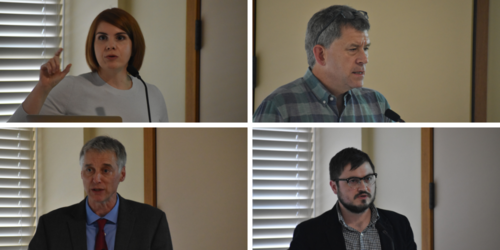
Shorenstein APARC convened a multidisciplinary panel of experts on October 24, 2019, to provide historical context and critical social science analysis to the unfolding horrors in Xinjiang Uyghur Autonomous Region (XUAR). Displaying the above quote from George Orwell’s 1984, Gardner Bovingdon, associate professor in the Central Eurasian Studies Department at Indiana University, characterized the mass detentions in XUAR as “one of the great, state-engineered human rights disasters of our time” and proceeded to describe the camps in Xinjiang as both “Orwellian and Kafkaesque.”
Over ten million Muslim minorities in the region are under lock-down control, and over one million Uyghurs and other Turkic Muslims have allegedly disappeared into internment camps. Beijing has characterized the camps as vocational training centers to fight Islamic extremism and recently claimed that most of the detainees have been released. Recent New York Times exposé based on an unprecedented leak of over 400-pages of internal Party documents made clear, however, that the camps are anything but job-training centers.
Broad Assault on Non-Han Culture
James Millward, professor of inter-societal history at Walsh School of Foreign Service, Georgetown University, gave a quick overview of the worsening political situation in the XUAR, especially since 2009, when violent race riots broke out in Urumqi, ignited by a conflict between Uyghur and Han workers in Guangdong. The bloody incident marked a major turning point in Han-Uyghur relations, and Beijing’s own recalibration of its own policies towards the Uyghurs. When in early 2010 and, again, in 2013-2015, jihadist-style terrorist acts broke out in XUAR, Beijing’s response in 2014 was to launch an all-out “strike hard campaign.”
That same year, Xi Jinping also called an important Central Ethnic Work Conference where the leadership adopted a new approach to ethnic dissent in the XUAR. Instead of relying, as before, on material improvements and economic developments to placate the Uyghurs and other Turkic Muslims in the XUAR, Xi Jinping now also prescribed the need for “spiritual or psychological” means (jingshenshangde (精神上的)) to manage ethnic strife. What followed, Millward described, were new national security laws and national counterterrorism laws with vague, broad language that allowed all types of measures to be implemented. Then, in 2016, Chen Quanguo, former Party Secretary in Tibet Autonomous Region from 2011-2016, was transferred to the XUAR to apply the same draconian securitization and surveillance system he had put in place in Tibet. Millward described 2016 as a “watershed moment,” a turning point in the crack-down on ethnic dissent in XUAR. The number of criminal prosecutions in Xinjiang suddenly skyrocketed over thirteen-fold from just 27,000 to 363,000 cases between 2016-2018. The number of new security facilities, including camps, prisons and even kindergartens, also spiked in the XUAR during the same period.
In addition to such judicial and extra-judicial methods of repression in the XUAR, this all-encompassing campaign also included draconian assaults on non-Han, Islamic culture. Beginning in the early 2000s, that assault has included the razing of old Kashgar; the illegalizing of any Islamic symbols such as women’s headgear, men’s beards; prayer, and fasting on Ramadan. What earlier started as official discouragement “turned into de facto laws,” he explained: “[Y]ou get locked up in a camp for this kind of behavior.” This “broad, broad attack” on the “symbols and central aspects of Uyghur culture” has also included the erasure of Uyghur script in public places; the disappearance of Uyghur intellectual and cultural leaders, including Rahile Dawut, a renowned anthropologist; and Tashpolat Tiyip, an internationally-recognized geographer and former President of Xinjiang University. One million Han Party members and officials have also been sent to southern Xinjiang to stay in Uyghur homes to spot signs of “extremism,” such as copies of the Quran, religious DVDs, etc.
Totalitarian Politics of Land
Lauren Hansen Restrepo, assistant professor in growth and structure of cities at Bryn Mawr College and an expert on urbanization in Xinjiang next spoke from the panel. She used the lens of urban planning to describe two significant shifts in Beijing’s techniques of governance over the Uyghur population in the XUAR. From 2000-2009, before the Urumqi riots, the guiding principle for spatial development in Urumqi was that of a “dual-centered city” (shuangzhongxin; 双中心) – a relatively balanced vision with one development center located in the Uyghur heartland (Tianshan) and the other, in the Han super-majority region (Xinshi). This dual model of growth for Urumqi was abandoned in 2010, however, and a new spatial development policy called nankongbeikuo 南控北扩 or “control the south, develop the north” took its place. Construction halted in southern Urumqi where Uyghurs make up a majority of the population, and all resources were basically channeled to the northern part of the city.
In the wake of the 2014 Central Ethnic Work Conference, however, the “logic of total security” took over and there began a precipitous move towards what Restrepo called “a totalitarian politics of land.” The central government took control and began to more directly govern how development worked in XUAR. “Regional planning has broken every logic of urban planning in China,” she stated, resulting in the isolation and even greater marginalization of Uyghur-dominated urban centers. According to Restrepo, cities and larger regions in XUAR are being reconfigured to come under the direct management of central ministry-level powers and quasi-military entities called the bingtuan, respectively.
Open Air Prisons
Next, Darren Byler, an anthropologist who had recently received his Ph.D. from the University of Washington, focused on Uyghur dispossession and “terror capitalism” in the city of Urumqi. He first described the mass migration of Han people in the 1990’s into the XUAR, which caused increasing tensions with the Uyghurs.
With economic development, however, also came communications infrastructure, and in 2010, with the installment of 3G networks in Xinjiang, smartphone use began to spread. By 2012, nearly 40-50 percent of XUAR’s population were also on WeChat, China’s most popular messaging app. Uyghurs formed a vibrant, virtual public sphere on WeChat where they often formed networks centered on their religious identity. According to Byler, Uyghurs mainly focused on personal piety, rather than on political/radical forms of Islam. But after the violent jihadi-style attacks in 2013-2015, the Chinese state increasingly collapsed Islamism with radicalism extremism and equated visible signs of religiosity like beards on men, women’s veils and regular prayer with pre-terrorist tendencies. The impetus for this intense politicization of Islamism by the authorities, Byler also explained, originated with the U.S.’ war on terror.
The XUAR is a key zone of the Belt and Road Initiative and a region rich in natural resources, Byler pointed out, and control over this Northwestern area is essential to Xi Jinping’s ambitions. Byler described extensive use of cameras, digital media and biometric checkpoints, prisons, internment camps and, more recently, coerced labor to accomplish tight control over the Uyghurs. Byler also explained how, since the spring of 2017, the local police instituted a point-based ranking system for Uyghurs that assessed, for example, whether he or she owned religious tracts, his/her daily prayer practices, and ties to foreign countries.
In the internment camps themselves, the detainees undergo boot camp-style ideological and Chinese language training in conditions akin to medium security prisons. Pictures of blindfolded captives with their hands tied behind their backs, guards with tasers and weapons, all belied the Chinese government’s characterization of these camps as benign, vocational training centers. And, now, Byler described, in factories, such as textile factories, associated with these camps, detainees are coerced to provide low-cost labor at a time when average labor costs in China are rising. In a grim conclusion, Byler stated, “what's being built through this is . . . open air prisons. The whole space [of XUAR] is prison, it’s camps all the way down . . . . You can't move . . . without showing your I.D. and having your face scanned, and so it's just impossible to escape.”
State-engineered Human Rights Disaster
Indiana University’s Gardner Bovingdon, whose research focuses on politics in contemporary Xinjiang and the region’s modern history, was the last panelist to speak at the event. He first situated this “great, state-engineered human rights disaster[ ]” within the CCP’s framework of “minzu regional autonomy,” which the Party-state had established after 1949. Minzu being variously translated as “nationality” or “ethnicity,” the framework formally recognized and accorded some measure of political autonomy to people who are culturally different. In fact, however, communist ideology, Bovingdon noted, has always faced tensions between (i) “the goal of respecting and protecting cultural difference” and (ii) “the goal of integrating the land and the peoples into a unified polity.”
According to Bovingdon, prior to 2009, commercialization of Uyghur culture through tourism and consumption seemed to be the Party’s preferred way of dealing with the securitization problem in the XUAR. But the CCP’s ever-shifting attitude towards the nation’s multi-ethnicity issue went all the way back to the Soviet collapse in 1991. The paramount concern of the Chinese Communist Party ever since has been to avert the outcome that had felled their erstwhile communist neighbor and preserve the Party and the nation. Scholarly responses to the Soviet collapse in the 1990’s included an analysis that exhorted the government to “weaken the concept of minzu and minzu consciousness”; lessen “minzu centrism” and vitiate the notion of minzu independence. Exhortations to “de-politicize and culturalize” the problem of ethnic minorities continued into the 2000’s. Then, more recently, scholars have proposed moving away from policies that mimic those of the former Soviet Union and adopting “second generation minzu policies” that promote “fusion and collective flourishing” of the various peoples.
Regardless of the official academic discourse, however, Bovingdon asserted that the best explanation for policy changes in the XUAR remained the transfer of Chen Quanguo as Party Secretary from Tibet to Xinjiang in 2016. Under him, the Chinese Communist Party transported and scaled-up a set of policies that had previously been applied to the unrest in Tibet. These policies do not “weaken” minzu consciousness, Bovingdon suggested, but rather intensifies them. These policies are, in fact, “signs of a flailing, terrified Party,” Bovingdon asserted, “that doesn’t know what to do with the Uyghurs, but also feels no constraints from the international community on its behavior. And so the biggest problem now is to find a way to put constraints on a system that has operated untrammeled with devastating consequences.”