
Celebrating SPICE’s 50th: The Start of the Western Europe Project
Celebrating SPICE’s 50th: The Start of the Western Europe Project
Stanford alum and former Coordinator of the Western Europe Project Dr. Susan J. Duggan shares reflections on her career.

This article was written by Dr. Susan J. Duggan, initial Coordinator of the Western Europe Project at SPICE (1988–1990). In its early years, SPICE comprised several separate area-focused projects. This is the eighth of several articles—focusing on the 50-year history of SPICE—that will be posted this year.
Happy 50th Birthday to SPICE! I am honored to be part of this special group of multi-talented, internationally experienced educators and innovators.
I came to SPICE in a roundabout way. After studying in France and Italy during my undergraduate years at Stanford, I did my first master’s degree in Political Science (international relations) at Université Laval in Québec in 1980. My thesis was on the political role of educational exchange in Québec’s desire for sovereignty (from Canada). Upon returning to my home in California, I landed a job as the Project Associate at the “Bay Area and the World Project” hosted at the World Affairs Council in San Francisco and sponsored, among others, by Stanford University. In that small, windowless office Dr. Ron Herring discovered me researching the connections between the Bay Area and other countries; and promoting those connections through our publications and conferences with businesses, local governments and educators. He convinced me to come back to Stanford to get my Ph.D. That was the beginning of my SPICE connection, though it would be another six years before I officially worked for SPICE.
Initially, I pursued a second master’s degree in Education at Stanford. That is when I met Dr. David Grossman at the Center for Research in International Studies (CRIS), the predecessor to the Institute for International Studies (IIS), now FSI. I have fond memories of working on a research project looking at young U.S. students’ perceptions of Germany and Germans. David was there in Berlin when I began my field work for my dissertation in 1985. David and Ron encouraged me throughout my pre-SPICE time to explore the role of educational exchange, not only for students, but also for teachers.
Ron recruited me to be the initial coordinator of the newly founded Western Europe Project in 1988. I had just finished my dissertation at the Graduate School of Education at Stanford on the political role of educational exchange between Germany and the United States and was eager to work with the SPICE folks on curriculum development for K–12 students and teachers. Dr. Judy Wooster had just assumed the leadership of SPICE. I had a lot of fun working with this bright group of creative folks!
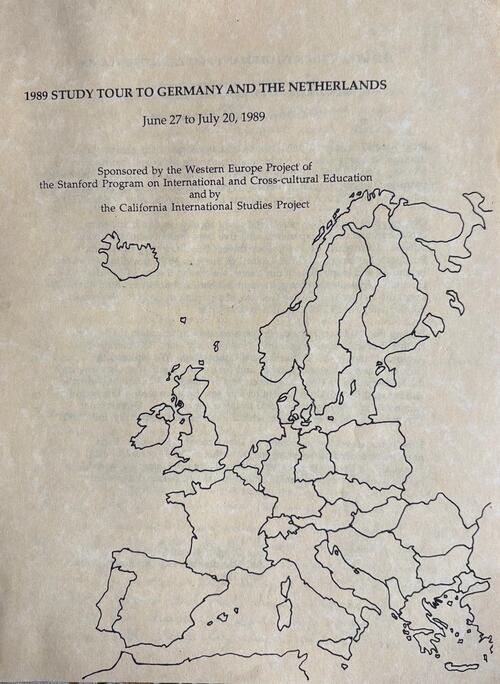
In the summer of 1989, Ron asked me to help coordinate and run a study tour of American teachers to Western Europe. SPICE and the California International Studies Project (CISP) sponsored the tour. I had experience having co-founded the “Berlin-California Teachers Exchange” in 1985 with friend, colleague, and teacher Flex Ninow from the Internationale Lehrerkonferenz Berlin. In our 1989 tour (photo above courtesy of Sue Duggan), 12 brave teachers spent 24 intense days in Berlin; southern Germany (Weinstadt); Strasbourg; and on to Zeeland, Amsterdam and North Holland in the Netherlands.
The participants focused on two main themes for eventual curriculum development: “Communities, Regions, Nations” and “Conflict and Cooperation.” Mind you, this was the summer of 1989. The study tour focused on Western Europe and what would evolve, eventually, into the European Union. They heard, of course, analyses and speculation about Eastern Europe and Soviet aspirations. In retrospect, what an honor it was to hear from so many European teachers, politicians, political scientists, and regular folk about their perceptions of a 1989 version of Western Europe. No one among our many European interlocutors imagined that the Berlin Wall would fall just a few months after our departure creating a huge change in the political, economic and educational landscape of all of Europe.
In the early months of 1990, I felt compelled to return to Berlin to gather fresh insights about the Fall of the Berlin Wall (which had happened on November 9, 1989, just three and a half months after our return from the SPICE Study Tour). I imagined how hearing from real Germans about an actual historical event could inspire American high school students studying German. I pitched the idea to Judy Wooster along the lines of “Where were you when Kennedy was killed?” I wanted to hear from a variety of Berliners—from the East and West—about where they were when they heard the news of the Berlin Wall being taken down. Remember, there were two parallel walls that bisected the city of Berlin. For some, they only knew the existence of a divided city. For others, they had strong memories of the Wall being built, starting on August 13, 1961. I bought a Sony Walkman and a ticket to Berlin. I was able to line up interviews with various people, from politicians, to teachers, to a pub owner, and even a Berliner in her 60s who not only remembered when the Wall was built, but what happened during the Berlin Airlift (1948–1949) in her hometown. I came back to SPICE with precious recordings of remembrances and personal connections to one of the biggest changes in the latter part of 20th century Europe.
Possibly because of the Study Tour and the inspiration to record the voices of Berlin after the Wall fell, I felt drawn to return to Germany. The Alexander von Humboldt Stiftung (Foundation) created a new program in 1990 called the “Chancellor Scholars” bringing young, professional Americans to Germany to witness the unfolding of a new version of Europe. I was recruited to be in the initial group. I could not turn that down. With reluctance mixed with anticipation to experience a “whole” Germany, I left my position at SPICE in September 1990. I was pleased to leave the Berlin Perspectives curriculum unit in the capable hands of my successor, and even more pleased that that unit still exists today.
I have always considered myself lucky to have been part of the developing times of CRIS, IIS, and SPICE. I enjoyed smart, fun, creative colleagues who really cared about the world, education, and each other. Dr. Steve Thorpe, formerly the coordinator of the SPICE China Project, and I finished our PhDs around the same time and have stayed in touch all these years. Dr. Ron Herring is “Uncle Ron” to my daughter, Coral. Gosh, even the SPICE folks survived the Loma Prieta Quake together in the basement of Littlefield Center at 5:04 p.m. on October 17, 1989!
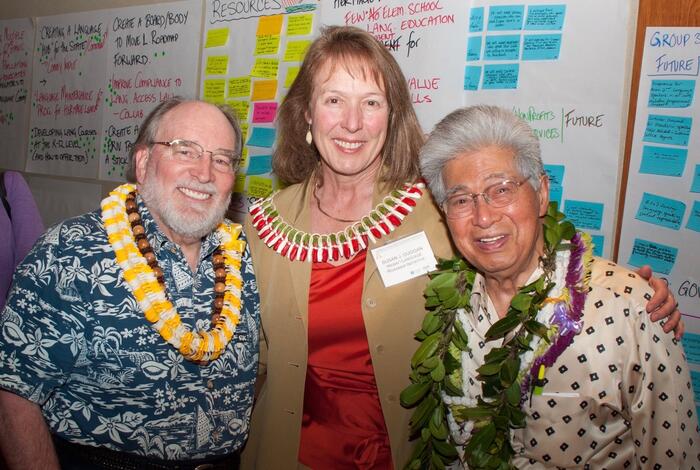 Photo above: Governor Neil Abercrombie of Hawai‘i, Dr. Susan Duggan, Executive Director of the Hawai‘i Language Roadmap Initiative, and Senator Daniel Akaka, 2013 | courtesy of Susan Duggan.
I have enjoyed a career mostly in international education. After SPICE and the Humboldt year, I started an international study abroad program in formerly Eastern European countries. I became the Senior Research and Policy Consultant to the National Security Education Program and ended up on the founding team that created the Boren Scholarship Program. Later, as Senior Strategist, I helped shaped The Language Flagship, now comprised of 14 U.S. universities with language and cultural studies in South Korea, Taiwan, Brazil, Morocco, and Kazakhstan. Toward the end of my career, I had the great pleasure of re-connecting with the K–12 sector as I created and ran many state Language Summits to create Language Roadmaps for those states. At times I have branched into the areas of high tech and agricultural tech innovations, but always with an international connection. I feel my early years at SPICE prepared me well for working with a variety of people in education, business, and government, all with creativity and integrity.
With gratitude, I wish SPICE—and all those involved with this wonderful program—a very happy 50th anniversary!
To stay updated on SPICE news, join our email list and follow us on Facebook, X, and Instagram.

