
New Book by Chenggang Xu Unpacks the Deep Roots of China’s Totalitarian Regime

New Book by Chenggang Xu Unpacks the Deep Roots of China’s Totalitarian Regime

SCCEI Senior Research Scholar Chenggang Xu’s latest book, "Institutional Genes: Origins of China's Institutions and Totalitarianism", explores the origins and evolution of China's institutions and communist totalitarianism.

SCCEI Senior Research Scholar Chenggang Xu’s latest book, Institutional Genes: Origins of China's Institutions and Totalitarianism, offers a reinterpretation of China’s political and institutional development. Drawing from decades of research, Xu introduces the concept of "institutional genes"—the enduring foundational structures that shape and constrain how institutions evolve. Through this lens, he examines the emergence and evolution of China’s current communist totalitarian institution, contending that substantial parts of its "institutional genes" were implanted by Soviet Russia, building upon a longstanding tradition of authoritarian rule dating back to imperial China.
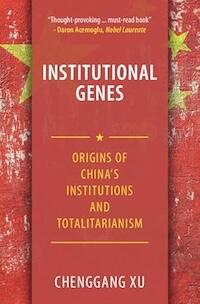
Book cover: Institutional Genes: Origins of China's Institutions and Totalitarianism by Chenggang Xu

With insights spanning political economy, institutional economics, and history, Institutional Genes presents a compelling account of why China’s institutions have taken their particular form—why they have resisted democratization—and why its economic reforms have risen and fallen. Xu’s work will appeal to scholars, policymakers, and general readers seeking a deeper understanding of how China’s past continues to shape its political trajectory today. 

Institutional Genes: Origins of China's Institutions and Totalitarianism, previously published in Chinese, is currently available for pre-order and will be published and available to the public on August 21, 2025. For more from Xu, read his recent essay, The Origins of China’s Institutions and Totalitarianism, based on his forthcoming book.


Headshot of Dr. Chenggang Xu.

Chenggang Xu

Senior Research Scholar, Stanford Center on China's Economy and Institutions
About the Author

Read More

Landscape aerial view of Haikou City, China.
News

Shanjun Li to Lead New Research Program on Sustainability and Energy Transition in China

SCCEI's newest research program addresses the pressing sustainability challenges facing China and examines their broader global implications. Grounded in rigorous empirical analysis and economic modeling, researchers aim to inform the development of effective evidence-based policy solutions as well as uncover valuable lessons for other countries navigating similar economic and energy transitions.
Shanjun Li to Lead New Research Program on Sustainability and Energy Transition in China
Elizabeth Economy speaks during a Fireside Chat.
News

Strategic Shifts: Understanding China’s Global Ambitions and U.S.-China Dynamics with Elizabeth Economy

At the 2025 SCCEI China Conference, Elizabeth Economy, Hargrove Senior Fellow at the Hoover Institution, outlined China’s ambitious bid to reshape the global order—and urged the U.S. to respond with vision, not just rivalry, during a Fireside Chat with Professor Hongbin Li, Senior Fellow and SCCEI Faculty Co-Director.
Strategic Shifts: Understanding China’s Global Ambitions and U.S.-China Dynamics with Elizabeth Economy
Professor Matteo Maggiori speaks in front of a crowd.
News

Stanford Professor Matteo Maggiori Unpacks the New Geopolitics of Global Trade

Professor Maggiori joined SCCEI and Stanford Libraries to discuss how the U.S. and China apply economic pressure to achieve their political and economic goals, and the economic costs and benefits that this competition is imposing on the world.
Stanford Professor Matteo Maggiori Unpacks the New Geopolitics of Global Trade