
Studying Taiwan as a Window into Social Divides in a Changing World
Studying Taiwan as a Window into Social Divides in a Changing World
Pei-Chia Lan, who recently joined Stanford as the Wang and Chen Senior Fellow in Taiwan Studies, illuminates how globalization, migration, and geopolitics shape social inequalities in the most personal aspects of people’s lives, from parenting and eldercare to identity formation, and what Taiwan reveals about these dynamics.

When Taiwan transitioned from authoritarian rule to a multi-party democracy, Pei-Chia Lan was a college student. It was a time of civil resistance, constitutional and institutional reforms, and legislative elections. "Society was in a great transition, and we were very excited to be part of the process," she recalls.
She entered National Taiwan University as a law major, but after becoming involved in campus activism and increasingly invested in social justice, she switched to sociology. “It was a rare move at the time, but I was really passionate about the prospects of changing society,” she says. “I thought that studying sociology would help me achieve that goal."
This motivation has carried Lan across continents and through career achievements. As a qualitative sociologist, she investigates how macro-power dynamics, like globalization and international migration, interact with and shape everyday inequalities. By studying these issues from a transnational lens that places Taiwan in dialogue with other societies, her research offers valuable insights into inter-Asia connections and challenges shared by postindustrial economies.
On September 1, 2026, Lan was appointed the Wang and Chen Senior Fellow in Taiwan Studies at the Freeman Spogli Institute for International Studies (FSI), joining Stanford University from National Taiwan University, where she was a distinguished professor in the Department of Sociology. She is the first to hold FSI’s new chair in Taiwan studies, endowed by Steve and Jamie Chen along with other donors. She also serves as director of the Taiwan Program at the Walter H. Shorenstein Asia-Pacific Research Center(APARC), working to build the new program, established in spring 2024, into a university-wide hub that advances interdisciplinary research, education, and exchange on contemporary Taiwan.
Sign up for APARC newsletters to receive our scholars’ research and news updates >
Understanding Power Inequalities
After earning her bachelor’s and master's degrees at National Taiwan University, Lan crossed the Pacific to pursue doctoral studies at Northwestern University. The experience of being an international student on a then-predominantly white campus sparked her interest in questions of migration, race, and social class. By the time she returned to her alma mater as an assistant professor of sociology, after a postdoctoral fellowship at the University of California, Berkeley, her activist’s urgency had settled into a scholar’s patience. "I soon realized that changing society is very difficult. It takes time," she says.
She therefore set her sights on rigorous, socially relevant research. Drawing on ethnography and in-depth interviews, her human subjects research focuses on people from minority or marginalized groups. "For me, research is a way to learn about people's life experiences and personal identities, especially those of people who are different from us,” Lan observes.
She sees research as a form of communication, and a sociologist as a translator who interprets the forces that interact with and shape the everyday lives of diverse groups. “I think that sociological research can be a powerful medium to help people understand other groups from different backgrounds,” she says. “So when I write, I don't just write for academic audiences. Throughout my career, I have tried to write for the public.”
Lan’s first book, Global Cinderellas: Migrant Domestics and Newly Rich Employers in Taiwan (Duke University Press, 2006), delves into how economic disparities, immigration policies, race, ethnicity, and gender intersect in the relationship between migrant workers, primarily Filipina and Indonesian domestics, and their Taiwanese employers.
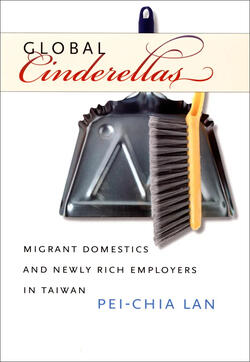
The book’s vivid ethnographic detail also reveals how structural issues shape that relationship. Beyond hierarchies of race and class, it is notably a dynamic between women. In this context, the migrant workers Lan interviewed frequently expressed a recurring sentiment: “Madame is difficult; the husband boss is nice to me.” Looking beyond personality to the structural pressures shaping Taiwanese female employers’ behavior, Lan explains that many are first-generation career women under pressure to be good wives, mothers, and daughters-in-law. They therefore set exacting standards and closely supervise their domestic workers because they are held responsible when the outsourced housework falls short.
One evening during fieldwork for the book, Lan was confronted firsthand with a lesson in power inequality. She was interviewing a Filipina worker who cared for an elderly couple in the Taiwanese countryside. The worker was off duty, and their conversation seemed relaxed until she mentioned that her employers disliked her having company.
Lan grew nervous. Was she causing trouble?
"Oh, don't worry," the woman told her calmly. "You are one of them."
It was a pivotal moment in Lan’s fieldwork. She had considered herself a skilled fieldworker, at ease with her subjects and immersed in Taiwan’s migrant community. "That moment really showed me how society works, how the power of social classification works," she says. "It was like seeing the boundary take shape right in front of me."
Social boundaries became the book's central conceptual framework for unveiling power inequalities. "And that's the sociologist's job: to unfold inequality, help us understand it, and, hopefully, bring social change."
Global Cinderellas won a Distinguished Book Award from the American Sociological Association’s Sex and Gender Section and a Best Study in Social Science book prize from the International Convention of Asian Scholars.
How Class and Cultural Divides Shape Inner Lives
As she continued to investigate the interplay between micro-processes of inequality and macro-forces of globalization and international migration, Lan turned her attention to how these forces are entangled with parenting and class divides. She realized she needed to explore how social class was structurally interconnected with migration in a transnational context.
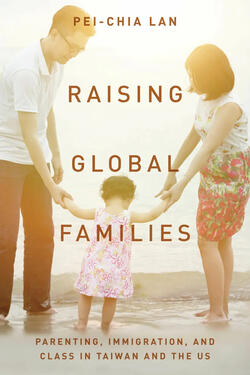
Thus, in her second English-language book, Raising Global Families: Parenting, Immigration and Class in Taiwan and the US (Stanford University Press, 2018, Open Access), she examines how ethnic Chinese parents in Taiwan and the United States negotiate transnational mobility, cultural boundaries, and class inequality in their child-rearing strategies. The trans-Pacific comparative perspective is essential to her analysis, and grew out of her 2011-2012 Yenching-Radcliffe visiting fellowship at Harvard University, when she interviewed immigrant parents in the Boston area.
Driven by the observation that modern parents seem more anxious than previous generations even though they are better resourced, Lan’s multi-sited ethnography explores how families across social classes adapt their parenting practices to navigate uncertainty, both within their communities and across national borders, demonstrating the different ways in which class inequality permeates the fabric of family life.
She describes how, in Taiwan, middle-class parents, weary of the academic pressure they grew up with, take on a bigger role in their children’s schooling, compared with previous generations, and seek to cultivate Western cultural capital through alternative education choices, such as Waldorf schools, imagining American children being raised happy in holistic education environments. By contrast, working-class parents without the time or resources to keep up feel that schools perceive them as unqualified.
Meanwhile, ethnic Chinese immigrant parents in the United States express anxiety about their children’s college admission prospects. Many see more permissive forms of parenting as "a kind of racial privilege only white middle-class families can afford" and choose to lean on Chinese values such as discipline and filial piety.
Lan’s work helps disentangle how culture operates in people's lives. “We tend to imagine ethnic culture as fixed, like a backpack immigrants carry when they come to the US,” she says. Her transnational study shows that people continuously renegotiate culture in response to the social forces they face.
Lan's current book project turns to Taiwan's changing population, focusing on the influx of marriage migrants and their children of mixed heritage. Here, too, she highlights how geopolitics, migration, and contesting boundaries shape daily experiences and identity formation, particularly of second-generation adult children born of intermarriages.
Cross-border marriage has become a major driver of immigration to Taiwan, attracting women from Southeast Asia and mainland China to establish families or pursue opportunities for upward mobility. Lan finds that, since Taiwan launched its New Southbound Policy in 2016 to deepen ties with Southeast Asia, South Asia, and Australia, children of Southeast Asian immigrant mothers have seen their ethnic background, once treated as a liability, recast as an advantage. Children of mothers from mainland China experience the opposite process. Amid rising cross-Strait tensions and geopolitical competition, they feel either forced to mask their identity or pressured to prove their loyalty to Taiwan.
At the core of this study lies a fundamental question: Who is Taiwanese? “The boundary of Taiwanese identity has shifted along with the changing composition of Taiwan’s population, and marriage migrants now constitute a new chapter in that story of transformation,” Lan explains. “I hope my book can contribute to understanding this changing picture."
Titled Border of Identities: Multiculturalism, Geopolitics, and the Second Generation in Taiwan, this manuscript is under contract with the University of California Press.
Taiwan and the World
Why is it important for Stanford to study contemporary Taiwan? Many answers point to the island’s role as a geopolitical flashpoint or as a global leader in semiconductor manufacturing and innovation. Lan’s reply centers on Taiwan as a window into global societal changes. “Taiwan stands at the intersection of many of the most important issues of our time,” she said when her appointment was announced. "Taiwan deserves to be studied and understood not only on its own terms, but also for what it can teach us about a rapidly changing world."
For example, Taiwan offers a lens on the challenges of an unfolding demographic transition. As fertility rates decline and populations age, who will care for the elderly? Across East Asia, families have long shouldered that responsibility, but shrinking kinship networks severely strain this informal support system. Taiwan’s response to this growing pressure is, in Lan’s words, “subcontracting filial piety”: families outsource the care for aging parents to the market, often to migrant workers.
Yet shared pressures do not necessarily produce identical solutions, or, in this case, care arrangements that fit neatly into regional categories. Thus, Taiwanese families tend to hire live-in caregivers to keep aging parents at home and “maintain the facade of three-generation cohabitation,” Lan explains. In this regard, Taiwan’s approach is more akin to countries such as Italy, Spain, or Greece than, for example, to Japan, where migrant caregivers are less readily accepted in the home and therefore mostly staff hospitals and nursing homes.
Lan points out that underneath this variation lies a global paradox: care is intimate labor, yet language, class, culture, and citizenship divide caregivers and care recipients. The questions that follow are universal: What does good care mean across those boundaries? How should we protect migrant workers against exploitation? And how can we build solidarity in relationships marked by power inequality? Taiwan’s experience offers a beneficial lens for grappling with these questions.
Another example comes from the vastly different arena of democratization and democratic resilience. “Taiwan is the only vibrant, fully functioning democracy in the Chinese-speaking world," Lan reminds us. Other countries could benefit from understanding the island’s development into a high-quality liberal democracy, but that requires considering the full picture of its political system, culture, and social dynamics. At the same time, Taiwan exhibits weaknesses and faces headwinds that threaten its democracy. These, too, offer lessons for addressing democratic backsliding.
In the technology sector, the United States and other countries now look to Taiwan’s ascent as a global chipmaker and seek to replicate TSMC's success story at home. “But there is an important cultural and social infrastructure behind Taiwan's chip dominance, and behind the accomplishments of its IT industry more broadly, that has to be understood first,” Lan stresses.
She envisions the Taiwan Program as promoting this nuance and depth in understanding contemporary Taiwan. The program’s mission encapsulates this idea in the statement “studying Taiwan in the world – and the world through Taiwan."
A New Stanford Intellectual Hub
Lan brings to her new role experience in academic program administration and recognition as an esteemed educator. At National Taiwan University, she served as founding director of the Global Asia Research Center and received five teaching awards. Her appointment as a senior fellow at FSI and director of the Taiwan Program marks her return to the Farm, having spent the 2024-25 academic year as a Stanford-Taiwan Social Science Fellow at the Center for Advanced Study in the Behavioral Sciences. Under her leadership, the Taiwan Program at APARC will work across three areas: research, education, and exchange.
Lan plans to bring visiting scholars and Stanford faculty together to produce policy-relevant research on contemporary Taiwan and its evolving challenges. In her view, understanding Taiwan means unveiling the connections that link it to other societies. Her fieldwork in the Philippines, Indonesia, and Vietnam followed labor mobility. She is now turning her attention to connections between Taiwan and the United States, tracing the flow of talent, capital, and culture. The program's research agenda will carry this transnational approach that defines her work – a perspective that emphasizes relationships across borders. "When we talk about comparative research, we tend to see different societies as distinct units," she explains. “A transnational approach examines how societies are connected and how their connections shape them.”
The program will also aim to cultivate the next generation of experts and scholars in Taiwan studies. Lan will offer a course on global Taiwan and teach in FSI's Ford Dorsey Master's in International Policy program. In the future, the program may also bring Stanford students to Taiwan for summer courses.
Intellectual exchange will connect these efforts. Through visiting fellowships, event programming, and collaboration, Lan sees a hub that fosters interaction between Stanford faculty and students and their counterparts in Taiwan and, by extension, a platform that strengthens engagement between Taiwan and the United States. The program’s annual conference, which alternates between Stanford and Taiwan, serves as a forum for developing those relationships.
The 2027 conference, to be held in Taiwan, will focus on talent and labor migration in relation to the technology industry, examining questions that matter deeply to both Taiwan and the United States. When the conference returns to Stanford the following year, Lan plans to spotlight Taiwan’s science and technology parks, drawing on an interdisciplinary project she is part of. “I think that will offer an interesting and productive contrast with Silicon Valley,” she predicts. TSMC’s experience in Arizona and elsewhere could extend that discussion, connecting Taiwan’s industrial development to wider questions about the global movement of technology, investment, and human capital.
She hopes the Taiwan Program becomes home to a community whose reach extends beyond academia. “That’s a good way for us to build bridges across disciplines, across the Pacific, and between the university and its neighbors.”


