
Public Preschool Aids in Developmental, Learning-Related Diagnoses
Public Preschool Aids in Developmental, Learning-Related Diagnoses
New research by SIEPR and SHP scholars Adrienne Sabety and Maya Rossin-Slater shows how early exposure to public preschool benefits low-income children with behavioral and developmental conditions.

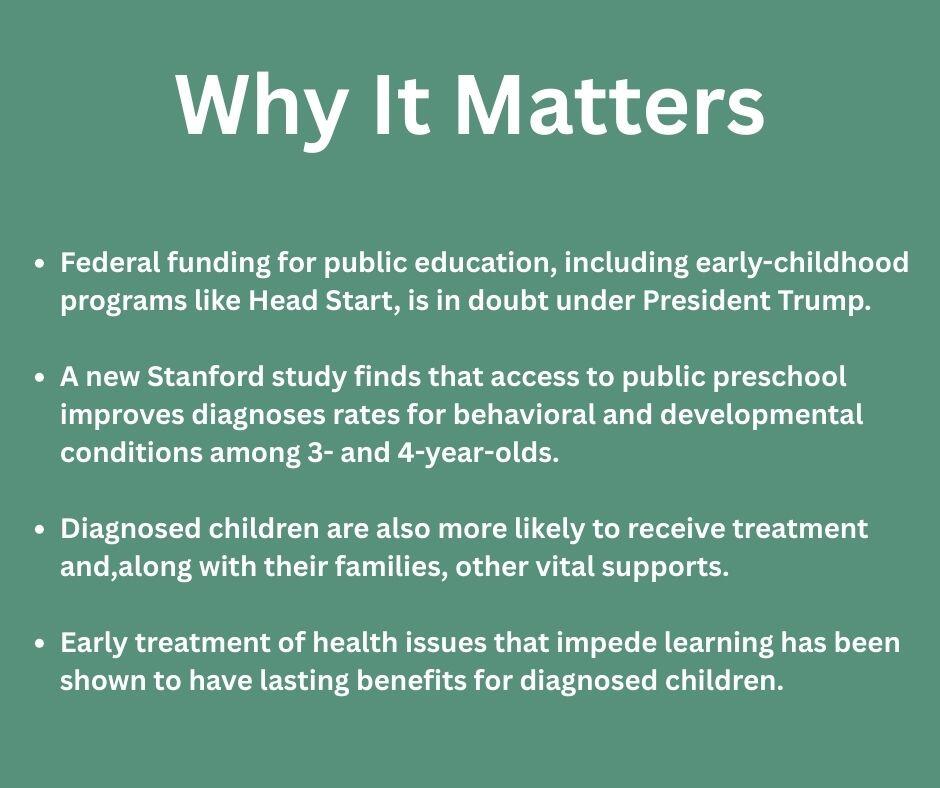
A new Stanford study points to publicly funded preschools playing a key role in identifying developmental challenges among young children from low-income families in the U.S., where early treatment can have lifelong benefits.
Analyzing Medicaid data from 32 states, the researchers conclude that attending public preschool improves diagnoses rates for kids between the ages of three and four who have speech or language impairments, problems with hearing and vision, or ADHD. Once their conditions are identified, these children are then more likely to get treated and, along with their families, receive other vital supports.
The findings — which apply to low-income children across race, ethnicity, sex and geography — are significant as numerous studies have shown that diagnosing and treating children for health issues that impede learning benefit from improved educational and health outcomes, both in the short and long run.
What’s more, the new Stanford study finds that attending public preschool results in diagnoses for kids with behavioral and developmental conditions that would otherwise go undetected.
“Early childhood is a critical window for intervention, not just for diagnosed students but also their families,” says Adrienne Sabety, a faculty fellow at the Stanford Institute for Economic Policy Research (SIEPR) who conducted the study along with Maya Rossin-Slater, a SIEPR senior fellow, and Aileen Wu, a SIEPR predoctoral research fellow. Sabety is also an assistant professor of health policy, and Rossin-Slater an associate professor of health policy, in the Department of Health Policy at the Stanford School of Medicine.
Their study, released as a working paper by the National Bureau of Economic Research, is among the first to look at the role of modern public preschools in connecting children — including those with developmental challenges — and their families to health care and social services. And it sheds new light on a phenomenon that researchers have long seen occurs in kindergarten, when kids turn age 5, but don’t yet have a clear understanding for why it occurs: The youngest students within a class tend to be diagnosed with mental health-related issues at much higher rates than their older peers.
Sabety, Rossin-Slater and Wu document the same pattern in preschool. Three- and 4-year-olds born right before their state’s cutoff date for attending public school, they show, are far more likely to be diagnosed with a speech or language disorder, a hearing or vision condition, or ADHD than children born right after the cutoff date.
The research also suggests that, when it comes to identifying preschoolers with developmental issues, the youngest 3-year-olds also are more likely to get diagnosed.
The study, which highlights the importance of public preschool for low-income children and their families, comes at a difficult time for government-funded education. Head Start, the federally funded early childhood education program created in 1965, faces an uncertain future amid a Trump administration bid to cut all of its federal funding and dismantle the Department of Education, which provides money to states to administer public preschool programs.
“Our results imply that ongoing cuts to funding toward public preschool programs like Head Start may have wide-reaching consequences for low-income families,” Sabety says, “by not only lowering access to early education and childcare, but also by delaying critical diagnoses and access to much-needed health and social services.”
This story originally was originally published by SIEPR staff writer Krysten Crawford.


