
How Gender Inequality Drives Talent Abroad and Keeps Women Away
How Gender Inequality Drives Talent Abroad and Keeps Women Away
Minyoung An, a postdoctoral fellow with the Korea Program and the Stanford Next Asia Policy Lab at APARC, studies how gender inequality shapes migration pathways and return decisions among South Korean highly skilled women, highlighting risks to Korea's long-term future and revealing that gender is a powerful yet often overlooked driver of global talent flows.
In Brief
- Gender inequality and rigid social norms in South Korea shape highly educated Korean women's decisions to leave the country and their reluctance to return.
- Gendered migration and return pathways vary sharply by national context.
- Treating talent flows as gender-neutral obscures a core driver of brain drain.

Why are highly educated South Korean women disproportionately more likely to leave Korea than men, and why do many of them choose not to return to their home country?
Minyoung An, a 2025-27 Korea Program postdoctoral fellow at APARC, sets out to answer this question in her research on gendered migration patterns among South Korean women, which she presented at a recent Korea Program seminar. As a Korean woman who has herself migrated for academic training, An framed her presentation as both an empirical investigation and a question she continues to confront personally, situating her research within Korea’s broader challenges of inequality, demographic decline, and global talent competition.
Sign up for APARC newsletters to receive our scholars' research updates >
Gendered Selectivity in Migration
An began with a quantitative puzzle. Using data from the American Community Survey and Korean census microdata, she examined educational selectivity among Korean immigrants in the United States. Her findings show that immigrants are not a random subset of the population but are positively selected in education and that this selectivity is significantly stronger for women than for men. Despite near gender parity in educational attainment, South Korea’s persistent workplace inequality and one of the largest gender pay gaps in the OECD appear to push highly educated women abroad at higher rates.
These patterns raise a deeper question: why is educational selectivity so strongly gendered?
Gender as a Push Factor
To answer this question, An turned to interviews with Korean women living in the United States, aiming to examine gender not merely as a background condition, but as a direct driver of migration decisions. Interviewees described gender-based exclusion, hostility toward feminists, and the suffocating effects of rampant sexism and rigid social norms as factors shaping both their decision to leave Korea and their reluctance to return.
An noted that one of the most surprising findings from her interviews was that gendered motivations were not limited to single women. Married women also described gender inequality as central to their migration choices, suggesting that family formation does not insulate women from structural constraints. For many, migration served as a means to escape environments they perceived as professionally and socially restrictive, made possible only by access to education, visas, and supportive networks.
Gendered Brain Circulation and Return Migration
An explained that her findings on South Korea raised a broader comparative question: If gender inequality shapes both out-migration and non-return among highly educated Korean women, does the same pattern hold elsewhere? To explore this possibility, she turned to return migration and what she calls “gendered brain circulation.”
Comparing South Korea and Taiwan, An finds that women trained in U.S. PhD programs are significantly less likely to return to South Korea than Taiwanese women to Taiwan. These contrasting patterns, she argued, reflect differences in gendered opportunity structures rather than education systems or levels of economic development. Treating talent flows as gender-neutral, she cautioned, risks obscuring how inequality shapes who leaves and who is able or willing to return.
The research also suggests that gender inequality-based migration pathways vary depending on national context, and that national strategies can unintentionally drive highly skilled women away.
Personal Stakes and Scholarly Community
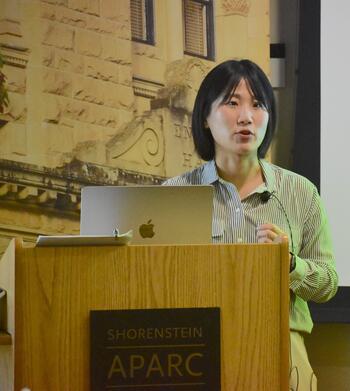
An concluded her presentation by reflecting on her own position within these dynamics. While uncertain about her long-term migration path and whether she will eventually return to South Korea, she described having found, for now, a sense of stability and belonging at Stanford, particularly as a postdoctoral fellow with the Stanford Next Asia Policy Lab. The fellowship, she noted, has provided a rare environment where independent research is paired with sustained mentorship, candid feedback, and a strong sense of scholarly community. These conditions shape not only academic productivity, but also how it feels to build a life and career abroad.
As An explained, “From day one, the lab members have welcomed me as a member of the team. The lab structure has allowed me to work at my own pace but stay motivated to get research done.” The sense of collegiality, she added, has made academic life abroad feel sustainable rather than isolating. “We also get along really well, and such a friendly environment has made it exciting to come into work every day. We even hang out outside of work after seeing each other five days a week,” she laughed.
One of the main implications of An’s research is that gender inequality is not only a social concern but also a structural force shaping migration decisions and national talent portfolios. Whether South Korea can retain, and eventually reclaim, its highly educated women, she suggested, will depend on whether gender inequality is treated not as a peripheral issue, but as a core constraint on the country’s future.
Key Takeaways: Gender, Migration, and Talent
- Gender inequality is a driving force behind migration decisions, shaping who leaves South Korea, with highly educated women more likely than men to migrate.
- Gendered opportunity structures reduce incentives for skilled women to return once they leave.
- Uneven return migration compounds Korea’s long-term talent loss.
- Treating talent strategy as gender-neutral risks overlooking structural barriers women face.
- Creating environments of belonging matters for retaining and reclaiming highly skilled women.


